

Master the art of project pricing with confidence, even if you’ve never freelanced before.
You’ve landed your first potential freelance client. They’re interested. They want a proposal. And then comes the question that makes your palms sweat: “How much will this cost?”
This moment is where many promising freelance careers stumble. Price too high, and you fear they’ll walk away. Price too low, and you’ll work for pennies while resenting every minute. The anxiety is real, but here’s the truth—learning to price projects correctly is a learnable skill, not an innate talent.
At Know Your Worth, we’ve seen countless freelancers transform their pricing confidence. Let’s break down exactly how to calculate project prices that respect your worth while remaining competitive.
Why Project Pricing Is Different (And Often Better) Than Hourly
Before we dive into the how-to, let’s understand why project-based pricing often makes more sense than hourly rates, especially as you gain experience.
The hourly rate trap: When you charge by the hour, you’re literally trading time for money. You become more efficient at your work, complete projects faster, and actually earn less. You’re penalized for being good at what you do.
The project pricing advantage: When you charge per project, you’re paid for the value you deliver and the outcome you create, not the time it takes. A logo that takes you 8 hours but transforms a client’s brand identity is worth far more than 8 times your hourly rate.
That said, when you’re starting out, thinking in hourly terms helps you build a foundation for project pricing. You’ll use your hourly rate as a baseline, then adjust based on other factors.
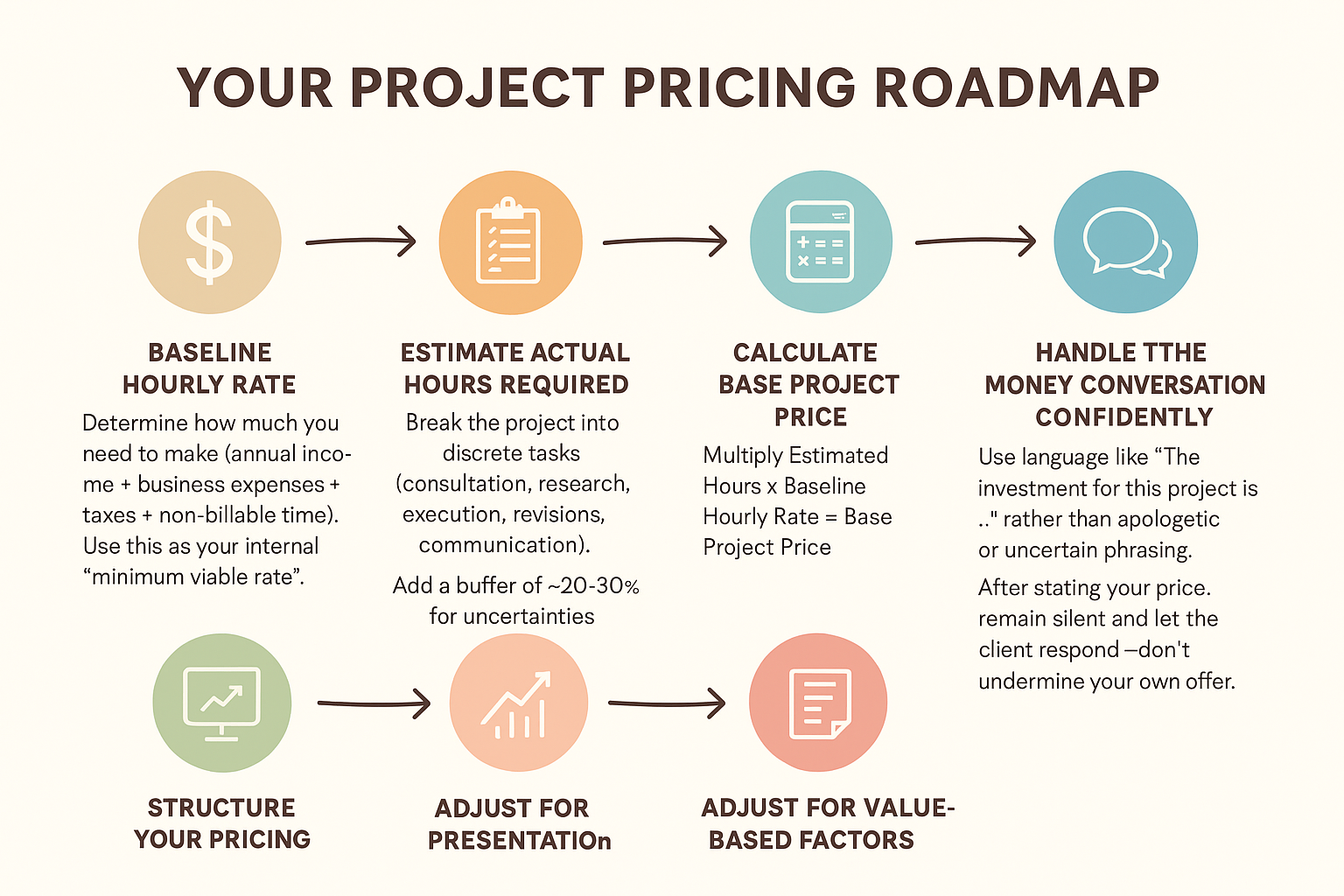
Step 1: Calculate Your Baseline Hourly Rate
Even if you plan to charge per project, you need to know your hourly worth. This becomes your internal compass for evaluating whether a project makes financial sense.
Use our hourly rate calculator to determine your baseline rate. This tool factors in:
- Your desired annual income
- Business expenses (software, equipment, workspace)
- Taxes (freelancers pay more than employees)
- Non-billable time (marketing, admin, professional development)
- Benefits you need to cover yourself (health insurance, retirement)
Example: Let’s say your calculator suggests a baseline rate of $75/hour based on your experience level, location, and financial needs.
This isn’t just a random number—it’s the minimum you need to charge to build a sustainable business. Anything less means you’re subsidizing your clients with your own financial security.
Step 2: Estimate the Actual Hours Required
Now comes the tricky part—figuring out how long a project will actually take. New freelancers consistently underestimate project hours, which is why so many end up working for less than minimum wage.
Break the project into specific tasks:
Let’s say a client needs a content marketing package. Don’t just think “write some blog posts.” Break it down:
- Initial consultation and strategy discussion: 2 hours
- Research and topic development: 3 hours
- Writing three 1,500-word blog posts: 9 hours (3 hours each)
- Editing and revisions: 3 hours
- SEO optimization: 2 hours
- Client communication and feedback rounds: 2 hours
- Total estimated hours: 21 hours
Add a buffer for the unexpected:
First projects almost always take longer than expected. Add 20-30% to your estimate to account for:
- Scope creep (small additions the client requests)
- Learning new tools or platforms specific to this project
- Extra revision rounds
- Technical difficulties
- Client delays that keep the project open longer
In our example: 21 hours × 1.25 = 26.25 hours (let’s round to 26 hours)
Pro tip: Keep a time log for your first several projects. You’ll quickly learn which tasks take longer than expected and improve your estimates dramatically.
Step 3: Calculate Your Base Project Price
This is straightforward math:
Estimated Hours × Your Hourly Rate = Base Project Price
Using our example:
- 26 hours × $75/hour = $1,950
This is your starting point—not necessarily your final price, but the minimum the project needs to be worth to make financial sense for your business.
Step 4: Adjust for Value-Based Factors
Here’s where you move beyond pure time calculations and consider the value you’re delivering. Ask yourself:
What’s the ROI for the client?
If your content marketing package could generate $20,000 in new business for the client, your $1,950 fee represents less than 10% of the value created. That’s a bargain.
Value multipliers to consider:
- Urgency: Rush projects should cost 25-50% more
- Expertise: Specialized knowledge deserves a premium
- Results: Outcome-based work is worth more than task-based work
- Client size: Larger companies with bigger budgets can typically pay more
- Usage rights: Will your work be used extensively? (e.g., a logo used for 10 years)
- Your uniqueness: Are you one of few people who can deliver this specific result?
For our example: If this is a standard project with normal timelines, you might stay at $1,950. But if the client needs it in half the time, or if your specialized industry knowledge is critical, you might adjust to $2,400-$2,500.
Step 5: Structure Your Pricing Presentation
How you present your price matters almost as much as the price itself. Never apologize for your rates or explain them defensively.
Option A: Single price (good for straightforward projects)
“Based on the scope we discussed, the investment for this project is $2,400. This includes [list specific deliverables], up to two rounds of revisions, and SEO optimization for each piece.”
Option B: Tiered pricing (great for giving clients choice)
Create three options at different price points:
- Essential Package: $1,950 – Core deliverables only
- Professional Package: $2,400 – Core deliverables plus additional value items
- Premium Package: $3,200 – Everything plus ongoing support, rush delivery, or extra revisions
Most clients choose the middle option, but presenting three prices makes your preferred option seem reasonable by comparison.
Pro tip: Always include what’s NOT included in your price. “This project does not include graphic design, paid advertising management, or social media posting” prevents scope creep and mismatched expectations.
Step 6: Handle the Money Conversation Confidently
When presenting your price, use confident, matter-of-fact language. You’re a professional presenting a fair price for valuable work.
Strong language:
- “The investment for this project is $2,400”
- “My rate for this scope of work is $2,400”
- “Based on what you’ve described, this project is $2,400”
Weak language to avoid:
- “I was thinking maybe around $2,400?” (Never make it a question)
- “I usually charge $2,400 but I could probably do it for less” (Never negotiate with yourself)
- “I hope this isn’t too expensive, but…” (Never apologize for your value)
After stating your price, stop talking. Let the client respond. Many freelancers panic in the silence and start offering discounts before the client even reacts.
Common Pricing Scenarios and How to Handle Them
Scenario 1: “Can you give me a ballpark estimate?”
Never give specific numbers without understanding the full scope. Ballpark estimates become anchors that are hard to raise later.
Response: “I’d want to ask a few questions about the scope before giving you a number. Could we schedule a quick call to discuss the details? That way I can give you an accurate price rather than a guess.”
Scenario 2: “We only have a budget of $X (which is below your rate)”
Response: “I appreciate you sharing your budget. For $X, here’s what I could deliver [reduced scope]. If you need the full scope we discussed, the investment would be $Y. Which would work better for this project?”
Scenario 3: “This is my first project, should I work for free to build my portfolio?”
Very rarely. Only consider this if:
- It’s for a high-visibility organization with a strong network
- You have complete creative control
- The client understands and acknowledges the value
- You set strict boundaries on time investment
Even then, provide a formal proposal showing the market value and clearly marking it as “donated” or “reduced for portfolio purposes.” Never let clients think your work has no value.
Scenario 4: “Can you work for exposure/equity/future payment?”
Unless you’re investing in your own startup, the answer is no. “Exposure” doesn’t pay your rent. If a business can’t afford to pay you, they’re not financially stable enough to be a good client.
Response: “I appreciate the offer, but I’m focusing on paid projects right now. If your budget changes, I’d be happy to discuss working together.”
Red Flags: When to Walk Away
Not every project is worth taking, regardless of the price. Watch for these warning signs:
- Client haggles aggressively or doesn’t respect your initial pricing
- Vague scope with phrases like “we’ll figure it out as we go”
- Requests for extensive free work before hiring you
- Unrealistic timelines or expectations
- Bad feeling in your gut about the client relationship
Remember: A bad client at any price will damage your business more than no client at all.
Building Your Pricing Confidence Over Time
Pricing gets easier with experience. Here’s what to do as you complete more projects:
Track everything: Keep records of estimated vs. actual hours for each project. Your estimates will improve dramatically.
Raise your rates regularly: Every 5-10 projects, or every 6 months, increase your baseline rate by 10-15%. Your skills are improving, and your pricing should reflect that.
Specialize: As you develop expertise in a niche, you can charge premium rates because you deliver results faster and with less client hand-holding.
Build a portfolio: Nothing justifies higher rates like proven results. Case studies showing tangible outcomes are pricing gold.
Create packages: Once you’ve done similar projects several times, create standardized offerings. This makes pricing easier and more consistent.
Your Pricing Success Formula
Let’s recap the formula for pricing your first (and future) projects:
- Know your baseline hourly rate using our rate calculator
- Break the project into specific tasks and estimate hours realistically
- Add 20-30% buffer for unknowns
- Multiply hours by your hourly rate for your base price
- Adjust for value-based factors (urgency, expertise, ROI)
- Present your price confidently without apologizing
- Be willing to walk away from clients who don’t respect your value
The golden rule: If you’re not occasionally losing projects because of your pricing, you’re probably charging too little. Not everyone will be your client, and that’s perfectly fine.
Start With Confidence, Not Perfection
Your first project pricing won’t be perfect. You might underestimate hours or misjudge value. That’s normal and expected. Every experienced freelancer started exactly where you are now.
What matters most is starting from a foundation of knowing your minimum viable rate—the number below which you simply cannot go and still build a sustainable business.
Use our hourly rate calculator to establish that baseline, then apply the steps above to price your projects with confidence. As you complete projects and track your actual time investment, your pricing will become increasingly accurate and profitable.
Remember: You’re not just pricing a project. You’re pricing your expertise, your time, your creativity, and the value you bring to your clients’ businesses. That’s worth fair compensation, even on your very first project.
What pricing questions are you struggling with? Share in the comments below—your question might become our next article!